
Big Corona Beach: The Crown Jewel of Corona del Mar

Big Corona Beach — officially Corona del Mar State Beach — is more than a picturesque crescent of sand. It is the geographic and emotional heart of Corona del Mar, a shoreline that has witnessed cattle ranching, silent films, surfing championships, Prohibition intrigue, and the transformation of a remote blufftop subdivision into one of Southern California’s most desirable coastal communities.
Drawing from The History of Corona del Mar by Douglas Westfall , the story of Big Corona is inseparable from the land, the harbor, and the ambition that shaped the village itself.
From Rancho Shoreline to Rocky Point
Long before beach umbrellas dotted the sand, the shoreline below today’s bluffs was part of Rancho Bolsa de San Joaquín, granted to José Andrés Sepúlveda in the 1830s. The land stretched from inland marshes to the Pacific, a vast cattle empire where thousands of animals roamed freely .
The coastline itself was rugged and largely untouched — known simply as Rocky Point. Ships occasionally grounded near the harbor entrance, giving the area both its name and a reputation for treacherous waters .
There were no roads, no piers, no beach houses — only bluffs, tidepools, and the open Pacific.
The Dream of a Seaside Resort (1904)
In 1904, developer George E. Hart purchased 706 acres from The Irvine Company and platted the village of Corona del Mar — “Crown of the Sea” .

Big Corona Beach was to be its centerpiece.
Hart envisioned:
- A 600-foot pleasure pier extending into the surf
- A bayside landing for visitors arriving by launch
- A Mission Revival bathhouse and pavilion
- A tent city rivaling Coronado
The pier was begun — and repeatedly destroyed by storms .
The bathhouse was planned — but never built.
Tent City existed mostly on paper.
For a decade, only a handful of homes rose atop the bluffs. The beach remained wide, raw, and largely empty — magnificent but isolated.
Jetties, Waves & the Birth of California Surf Culture
Everything changed with engineering.
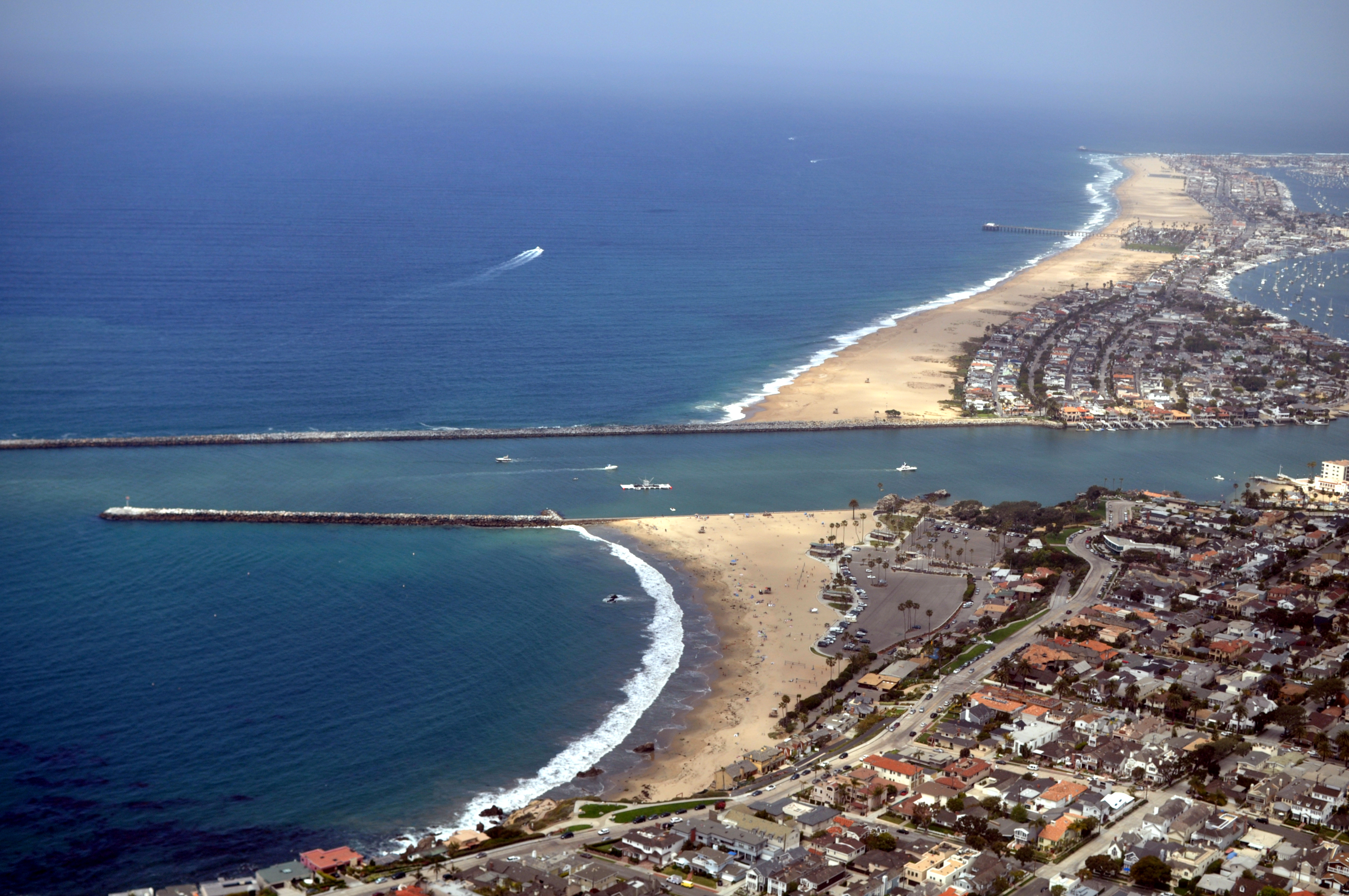
The construction of the west jetty beginning in 1917 and the east jetty soon after reshaped Newport Harbor . These massive rock arms altered wave patterns at Big Corona:
- Surf softened in some areas
- Swells reformed near the harbor entrance
- The famous Wedge was eventually born
By the 1920s, Big Corona had become one of California’s premier surf breaks.
The Corona del Mar Surfboard Club was formed here .
The Pacific Coast Surf Riding Championships were organized in 1928 by Tom Blake .
In those early competitions, surfers paddled 500 yards offshore around a buoy before racing back to shore on heavy wooden boards — the beginnings of organized mainland surf culture.
Big Corona was no longer remote ranchland — it was sporting history.
Hollywood Comes to the Sand
The dramatic cliffs and quiet coves below Ocean Boulevard became a natural movie set.
During the 1910s–1930s, film crews regularly used the beach and bluffs. Productions included:
- The Sands of Dee (1912)
- Macbeth (1916)
- Cleopatra (1917)
- The Sea Wolf (1919)
- Treasure Island (multiple versions)
- All Quiet on the Western Front (1929)
The Palisades Tavern (formerly Hotel Del Mar) housed film crews. Sets were built on the sand. Storm sequences were filmed in real Pacific swells.
Big Corona’s cinematic legacy is part of why its landscape still feels theatrical today.
Prohibition & Rumrunners
In the 1920s and early 1930s, Big Corona and nearby Crystal Cove gained another, more secretive identity.
During Prohibition:
- Liquor boats anchored offshore under darkness
- Cars flashed headlights from the bluffs
- Bootleggers smuggled cargo ashore
Years later, beachgoers would discover old bottles buried in the sand.
Even in isolation, Big Corona was connected to larger American stories.
From Private Shore to State Beach (1947)
For decades, Big Corona remained largely undeveloped shoreline beneath the growing blufftop village.
In 1947, through the determined efforts of early residents including Mary Burton, the land was acquired by the State of California and designated Corona del Mar State Beach .
This preserved:
- Public access
- The sweeping crescent of sand
- The unobstructed bluff views
- The character of the cove
Without that intervention, the shoreline might look very different today.
The Post-War Boom
After WWII, the population exploded.
By the late 1940s and 1950s:
- The Coast Highway widened
- New neighborhoods opened (Shore Cliffs, Irvine Terrace, Cameo Shores)
- Businesses lined PCH
- The elementary school opened
Yet Big Corona remained constant — the recreational heart of the growing village.
Beach picnics, junior sailing regattas, youth programs, and summer lifeguard towers replaced the cattle and film crews of earlier decades.
The Beach Today
Big Corona Beach remains defined by:
- Its gentle crescent shape
- Dramatic headlands and rock formations
- The harbor jetties framing the horizon
- Views toward Catalina on clear days
- Proximity to Little Corona tidepools
What began as Rocky Point ranchland became a developer’s gamble, a surfer’s proving ground, a filmmaker’s stage, and ultimately a protected public shoreline.
Its transformation mirrors the evolution of Corona del Mar itself.
Why Big Corona Matters
Big Corona Beach is not simply sand and water.
It is:
- The original economic draw of the village
- The backdrop to the early identity of Corona del Mar
- The site of California’s early organized surf culture
- A preserved public treasure secured before coastal privatization
When you stand at the waterline and look back toward Ocean Boulevard, you are seeing the same bluffs that:
- Silent film crews climbed in 1912
- Surfers gathered beneath in 1928
- Developers once feared might never attract buyers
More than a century later, George Hart’s dream of a “Crown of the Sea” endures — not because of the pier that never lasted, nor the hotel that changed names, but because the beach itself proved timeless.
Big Corona was always the real anchor of Corona del Mar.